Paper Over Pixels: The Gen Z Collagists Gluing Their Way Out of the Algorithm
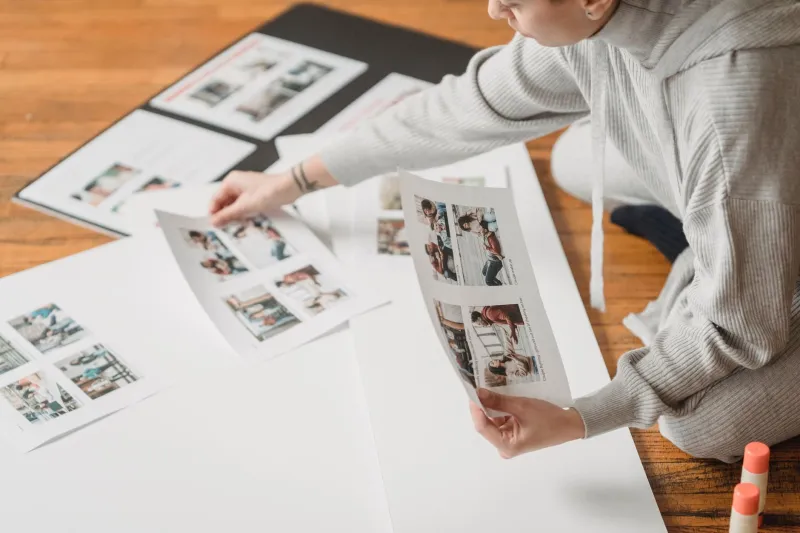
There's a particular kind of satisfaction in tearing a page out of a magazine. The sound, the jagged edge, the slight resistance before it gives. It's physical. It's irreversible. And for a growing community of young American creators, it's becoming one of the most meaningful creative acts of the decade.
Handmade scrapbooking and collage-making are having a moment — but calling it a "comeback" undersells what's actually happening. This isn't your mom's acid-free memory book from the Hobby Lobby clearance aisle. What's emerging across studio apartments, college dorms, and kitchen tables from Portland to Atlanta is something rawer, more intentional, and honestly kind of radical.
The Feed Is a Lie (And Everyone Knows It)
Ask anyone deep in the collage community why they started and you'll hear some version of the same answer: they got tired.
Tired of optimizing. Tired of the invisible pressure to post something that would perform. Tired of watching their own taste slowly homogenize under the weight of algorithmic suggestion.
"I used to spend like two hours editing a photo just to get the vibe right, and then it would get thirty likes and I'd feel hollow," says Maya, a 22-year-old design student in Chicago who now runs a private Instagram account dedicated entirely to her scrapbook pages. "The first time I made a collage that I didn't post anywhere — that I just made for myself — I felt more like an artist than I had in years."
That feeling is everywhere in this scene. The scrapbook, in its current form, functions less as a keepsake and more as a declaration: this is mine, it doesn't need your engagement, and it will never be optimized.
What's Actually Going Into These Things
The materials are half the obsession. Vintage magazines — particularly issues from the '70s through early 2000s — are among the most coveted sources. Old issues of National Geographic, Vogue, Sassy, SPIN, even obscure regional publications pulled from thrift stores and estate sales. The printing quality, the color palettes, the typography from those eras carry a texture that modern digital imagery simply can't fake.
Beyond clippings, scrapbookers are layering in washi tape, pressed flowers, receipts, ticket stubs, handwritten notes, photocopied diary entries, stamps, dried leaves, and basically anything with physical presence. The goal isn't nostalgia exactly — it's density. A page that rewards close looking. A page you could lose yourself in for ten minutes.
Etsy has become a significant sourcing hub, with sellers specializing in "ephemera lots" — curated bundles of vintage paper goods, labels, and clippings. Some of the more active Discord servers in this space have dedicated channels just for swap meetups, where members mail each other materials they've sourced locally.
"I sent someone in Vermont a stack of old Miami tourism brochures from the '80s and she sent me back this incredible collection of Japanese candy wrappers," says Dre, a 25-year-old in Houston who's been scrapbooking seriously for about three years. "There's a whole economy of generosity in this community that I've never experienced anywhere online."
The Underground Infrastructure
For a scene that's partly defined by rejecting public-facing platforms, it has a surprisingly robust digital backbone — just not where you'd expect to find it.
Private Discord servers are the beating heart of the collage underground. Some of the larger ones have hundreds of members sharing works-in-progress, sourcing tips, and technique breakdowns through voice channels and image drops. Entry is typically gated — you might need a referral, or to submit a few pages of your own work, or to answer a short questionnaire about your practice. The vetting feels intentional. The whole point is to build a space where the pressure to perform for an audience evaporates.
There are also Telegram channels, private Tumblr blogs (yes, Tumblr is genuinely thriving in this corner of the internet), and even a handful of zine-style newsletters distributed via Substack or direct email lists that function as collective scrapbooks themselves — contributors mailing in scanned pages that get assembled and redistributed.
TikTok has caught a whiff of this, because TikTok catches a whiff of everything. There are "process" videos — hands cutting, gluing, layering — that rack up millions of views. But the creators most embedded in the actual community are often ambivalent about the platform's attention. "Every time something goes viral, you get a wave of people who want to start a scrapbook because it looks aesthetic," says Maya. "Which is fine, I guess. But the whole point is to make something that doesn't care about looking aesthetic."
Collage as Self-Portrait
What separates this wave of scrapbooking from its early-2000s predecessor isn't just the aesthetic or the anti-algorithm ethos — it's the psychological weight the practice carries for its practitioners.
Therapists have been recommending collage-making as a tool for self-exploration for decades. What's interesting now is that young people are arriving at the same conclusion independently, without the clinical framing. These scrapbooks are being treated as genuine visual diaries — records of internal states, obsessions, fears, and desires that don't translate cleanly into words or photographs.
"My scrapbook is the most honest thing I make," says Jordan, a 20-year-old in Brooklyn who studies photography but describes their scrapbook practice as completely separate from their academic work. "It's the only place where I'm not thinking about whether something is good. I'm just thinking about whether it's true."
That distinction — between good and true — keeps coming up in conversations across this community. It points to something that the algorithmic content machine structurally cannot deliver: the freedom to be incoherent, unresolved, and entirely yourself.
Why This Matters Right Now
It would be easy to frame the scrapbook revival as a cute countertrend, a soft backlash to screen fatigue. But there's something more substantive happening here.
These creators are actively building an infrastructure — communities, economies, aesthetics — that exists outside the attention economy's jurisdiction. The work they're making doesn't generate data. It doesn't feed a recommendation engine. It doesn't make anyone money except maybe the thrift store that sold a stack of old magazines for three bucks.
In a media environment where nearly every creative act is immediately instrumentalized — turned into content, optimized for reach, harvested for engagement — making something that refuses all of that is genuinely countercultural. The scissors and the glue stick are not nostalgic props. They're the tools of people who decided, quietly but firmly, that their inner world was worth more than their metrics.
That's a pretty powerful thing to build on a kitchen table.