Wrapped in Public: The Guerrilla Fiber Artists Stitching Rebellion Into City Streets
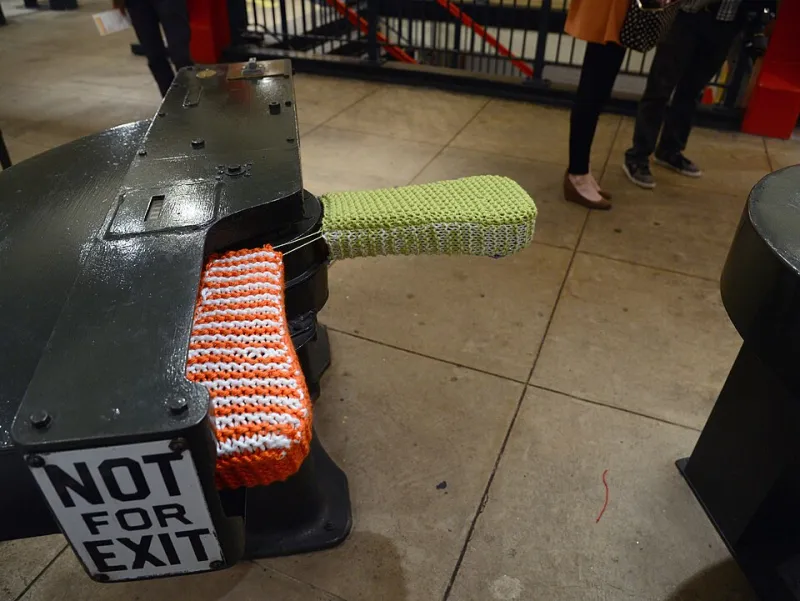
Photo: Metropolitan Transportation Authority of the State of New York, CC BY 2.0, via Wikimedia Commons
Somewhere in Portland, a stop sign is wearing a sweater. In Chicago, a chain-link fence has been slowly consumed by a riot of magenta and gold crochet panels. In Brooklyn, a lamppost woke up one Tuesday morning dressed in hand-knit geometric stripes, with a small tag attached that reads only: you are not alone.
Yarn bombing — the practice of covering public structures in textile art — has been bubbling under the surface of street art culture for over a decade. But something has shifted recently. What was once a quirky, largely solo pursuit has evolved into something with real organizational muscle behind it: coordinated collectives, encrypted group chats, late-night installation crews, and a growing sense that fiber art belongs on the street just as much as it belongs in a gallery.
And the people driving this new wave? A lot of them are in their twenties, deeply online, and completely fed up with art that exists only on a screen.
Needles Out, Walls Up
The traditional street art world has a gatekeeping problem. Graffiti culture — as vibrant and legitimate as it is — carries a long history of gendered exclusion. Muralism often requires institutional buy-in. Even sticker art has its hierarchies. Yarn bombing, by contrast, is radically accessible. You don't need expensive supplies, specialized equipment, or years of technical training. You need fiber, a hook or needles, and the audacity to go outside after midnight.
That accessibility is a huge part of why collectives like Denver-based Unravel Collective and LA's Tangled Dispatch have been able to grow so fast. Unravel, which started as a group chat between five friends who met at a local yarn swap, now coordinates installations involving upward of thirty contributors across the Front Range. Their pieces — which range from single wrapped telephone poles to full park bench transformations — are planned weeks in advance, with different members crafting individual panels that get assembled on-site like a textile puzzle.
"There's something really powerful about showing up at 2 a.m. with a bag full of knitting and a group of people you trust," says one Unravel member who goes by the handle @loopwitch_ online. "It's not just about the finished piece. It's about the act of doing something together, in public, that nobody asked permission for."
The Politics of Soft Materials
It would be easy to dismiss yarn bombing as cute — and that's kind of the point. Fiber art has historically been coded as domestic, feminine, and therefore not serious. The art world has spent decades slowly correcting that assumption, but the bias lingers. Yarn bombers are acutely aware of this, and many of them are leaning into the tension deliberately.
Tangled Dispatch, whose membership skews heavily queer and femme, frames their work explicitly as textile activism. Their installations often respond to specific local conditions — a piece installed near a shuttered community center, a wrapped memorial bench for a neighborhood figure, crochet panels hung on construction fencing around a displaced encampment. The softness of the medium, they argue, is not a weakness. It's a provocation.
"People stop and touch it," says Dispatch co-founder Marisol V., who asked that her last name be kept partial. "You don't touch a mural. You don't touch a sticker. But something knitted on a bench? People run their hands across it. They take photos. They read the tags we leave. It creates this moment of contact that feels different from any other street art I've encountered."
That tactile quality also makes yarn bombing unusually durable as a community-building tool. The pieces get photographed and shared, sure — Instagram and TikTok have both played a role in growing the scene — but the primary experience is physical. In an era when so much creative community formation happens entirely through screens, there's something almost radical about an art form that insists on being touched.
Gen Z Finds the Stitch
The demographic shift happening inside fiber arts right now is hard to overstate. Knitting and crochet surged during the pandemic — everyone has heard that story — but what's less discussed is how many younger crafters stayed, and radicalized. Platforms like Ravelry (despite its ongoing drama), TikTok's #CrochetTok, and a constellation of Discord servers have created spaces where Gen Z fiber artists are connecting around aesthetics and politics simultaneously.
For many of them, yarn bombing is the bridge between online community and real-world action. It's a way to take something learned through YouTube tutorials and Reddit threads and make it physical, public, and collectively owned.
Dani R., a 23-year-old in Seattle who joined a local yarn bombing crew last year, describes the experience as filling a gap she didn't know she had. "I was making stuff in my apartment and posting it, and it felt kind of hollow after a while. Joining the crew gave the work somewhere to go. It gave it stakes. You're not just making a pretty thing — you're putting it somewhere it wasn't supposed to be, and that changes what it means."
The crews themselves are often intentionally non-hierarchical, organized around shared aesthetic sensibilities rather than formal leadership. Many operate with a degree of anonymity — not necessarily because the work is illegal (yarn bombing occupies a legal gray zone that varies by city and installation method), but because the collective identity feels more aligned with the work's spirit than individual credit.
The Removal Is Part of It
Here's the thing about yarn bombing that separates it from almost every other art form: it's designed to disappear. Weather degrades fiber. Cities remove installations. Sometimes pieces get stolen — which the artists generally consider a compliment. The impermanence is baked in.
For a generation that grew up watching digital content vanish into algorithmic burial, there's something weirdly liberating about an art form that accepts its own mortality from the start. The piece exists, it does its thing, it goes away. The documentation lives on, but the object doesn't pretend to be permanent.
"I think that's why it doesn't feel precious," says @loopwitch_. "You make it, you put it out there, it lives its little life, and then it's gone. That's actually kind of beautiful? It forces you to care about the making and the moment, not about owning the outcome."
Where the Stitch Goes Next
Yarn bombing is not new, but the community organizing around it is getting sharper and more intentional. Collectives are starting to coordinate across cities — shared installation dates, cross-posted documentation, occasional collaborative pieces that span multiple locations simultaneously. There's talk, in some of the more ambitious group chats, of a national coordinated action.
Whether or not that materializes, what's already happening is significant. Fiber artists are building genuine communities around a shared practice that is tactile, political, accessible, and stubbornly analog. In a creative landscape increasingly dominated by digital output and platform dependency, that's not just charming — it's a quiet, woolly act of resistance.
Go touch a lamppost. You might be surprised what you find.