Spine and Soul: The Book Salvagers Turning Library Castoffs Into Art That Actually Hits
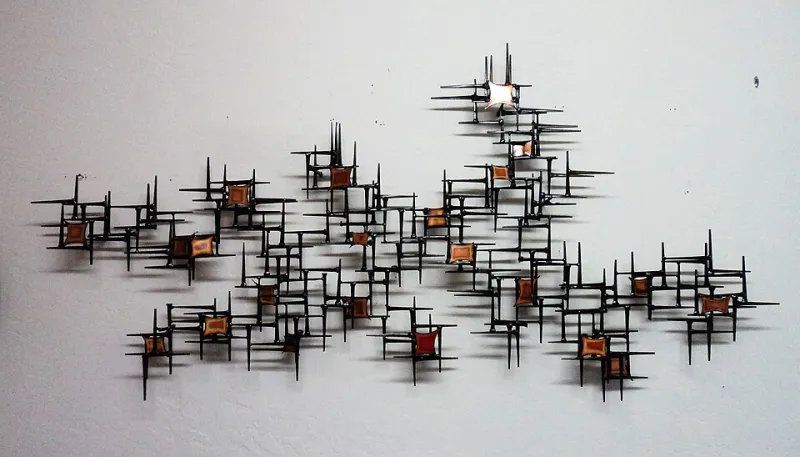
Photo: Modernmaven, CC BY-SA 4.0, via Wikimedia Commons
There's a particular kind of grief that comes with seeing a library discard cart. Those little stickers — WITHDRAWN, FOR SALE, $0.25 — feel like tiny verdicts. This book mattered once. Now it's surplus. But for a growing community of artists scattered across the US, those stickers are basically an invitation.
They show up to library sales before the doors open. They haul boxes from Goodwill and estate sales. They are not book collectors in any traditional sense. They're not trying to read these things. They are, in their own words, trying to listen to them — to what the covers say, what the spines suggest, what the yellowed pages smell like when light hits them just right.
And then they make something completely new.
What Counts as Fine Art, Anyway?
The conversation around book art — altered books, book sculpture, bibliographic installation — has existed in craft communities for decades. But something has shifted recently. The work getting made right now feels less like a hobby and more like a genuine aesthetic movement, one with something to say.
Artists working in this space are increasingly positioning their practice as a direct response to digital-first publishing culture. When everything is a PDF, an audiobook, a Kindle download, the physical book becomes a relic. And relics, it turns out, are excellent raw material.
"There's this assumption that because something was printed and bound, it's permanent," says Marisol, a Chicago-based mixed-media artist who has been building installations from discarded library hardcovers for the past four years. "But libraries throw away thousands of books every year. Museums deaccession things. The archive is not forever. I find that really interesting to work with."
Her most recent piece — a suspended grid of dust jackets from 1970s nature encyclopedias, backlit so you can see the paper's fiber structure — was shown at a small gallery in Pilsen and sold out its print edition in under a week. The original installation is touring.
The Material Is the Message
What makes this community distinct from, say, traditional collage or paper art is the specificity of the source material. These artists are not using blank paper. They are using books — objects with titles, authors, histories, and previous readers. That context is part of the work.
Dust jackets in particular have become a kind of obsession. Designed to sell, to catch an eye on a shelf, they're graphic artifacts that compress an entire era's visual language into a single rectangle. The typography alone — the fonts that scream "1983" or "mid-century optimism" — carries enormous cultural weight.
Brendan, a Portland artist who works under the name Marginal Notes, has spent the last two years building what he calls "cover portraits" — large-scale works that layer dozens of dust jacket fragments into composite faces. The results are uncanny and beautiful, like a memory of reading rather than reading itself.
"I think about who designed these," he says. "Some graphic artist, probably underpaid, probably forgotten. And I'm bringing their work back into a gallery context. That feels like something worth doing."
Critiquing the Culture Without Being Preachy About It
There's an implicit critique embedded in this whole practice — a side-eye at Amazon, at e-readers, at the algorithmic flattening of publishing — but the artists themselves are largely uninterested in being didactic about it. The work speaks for itself, and it speaks loudly.
When you walk into an installation built entirely from books that were deemed worthless by institutions, you feel something. It's not quite nostalgia. It's more like a reckoning. These objects held knowledge. They held someone's attempt to communicate across time. And we almost threw them away.
In Brooklyn, a collective called Foxed & Found has been hosting quarterly book-art pop-ups that double as community discard rescues. They partner with local library systems to take entire pallets of withdrawn books, sort them, and redistribute them to artists in their network. What doesn't get claimed becomes communal material for collaborative installations.
"We've processed something like eight thousand books at this point," says collective co-founder Ximena. "And not one of them has gone to a landfill. That matters to us."
Where This Is Headed
The scene is still small enough to feel genuinely underground, but the institutional interest is growing. Several book artists have had their work acquired by university collections. A few galleries that previously focused exclusively on painting and photography have started programming book-art shows.
More interesting, though, is what's happening on social media. Short videos of the creation process — the cutting, the layering, the unexpected beauty of a spine cross-section — perform remarkably well. Not because the algorithm loves books, but because people are starved for work that feels physical in a way that digital content fundamentally cannot.
There's something almost confrontational about watching someone carefully slice open a hardcover and reveal its inner structure on your phone screen. You're holding a device. They're holding a book. The contrast does the work.
For these artists, that tension is the whole point. They're not anti-technology. They're pro-texture. Pro-history. Pro-the-idea-that-something-discarded-still-has-something-to-say.
And honestly? The $0.25 sticker makes the finished gallery piece hit different.